

About the book
Byron Howard and Rich Moore's Zootopia dropped rookie bunny cop Judy Hopps into a city built for every mammal at once, from shrews to giraffes, and asked her to solve a case alongside a con-artist fox named Nick Wilde. The Art of Zootopia, written by Jessica Julius with input from directors Howard and Moore and producer John Lasseter, walks through how that city — and its two very different leads — actually got built, from the earliest sketches to the final frame.
First impressions
Chronicle Books went with a slightly smaller trim than most animation artbooks, and it works in the book’s favor — it feels less like a coffee-table slab and more like something you’d actually sit down and read cover to cover. The paper has a soft matte finish that keeps the vibrant color palette from turning glossy or overexposed, which matters a lot for a film this saturated. Nothing here feels rushed to hit a release date; every spread reads like it was laid out with care.
Content
The Art of Zootopia. 160 pages, hardcover, Chronicle Books, written by Jessica Julius. Released in March 2016, timed to the film’s theatrical debut.
Characters
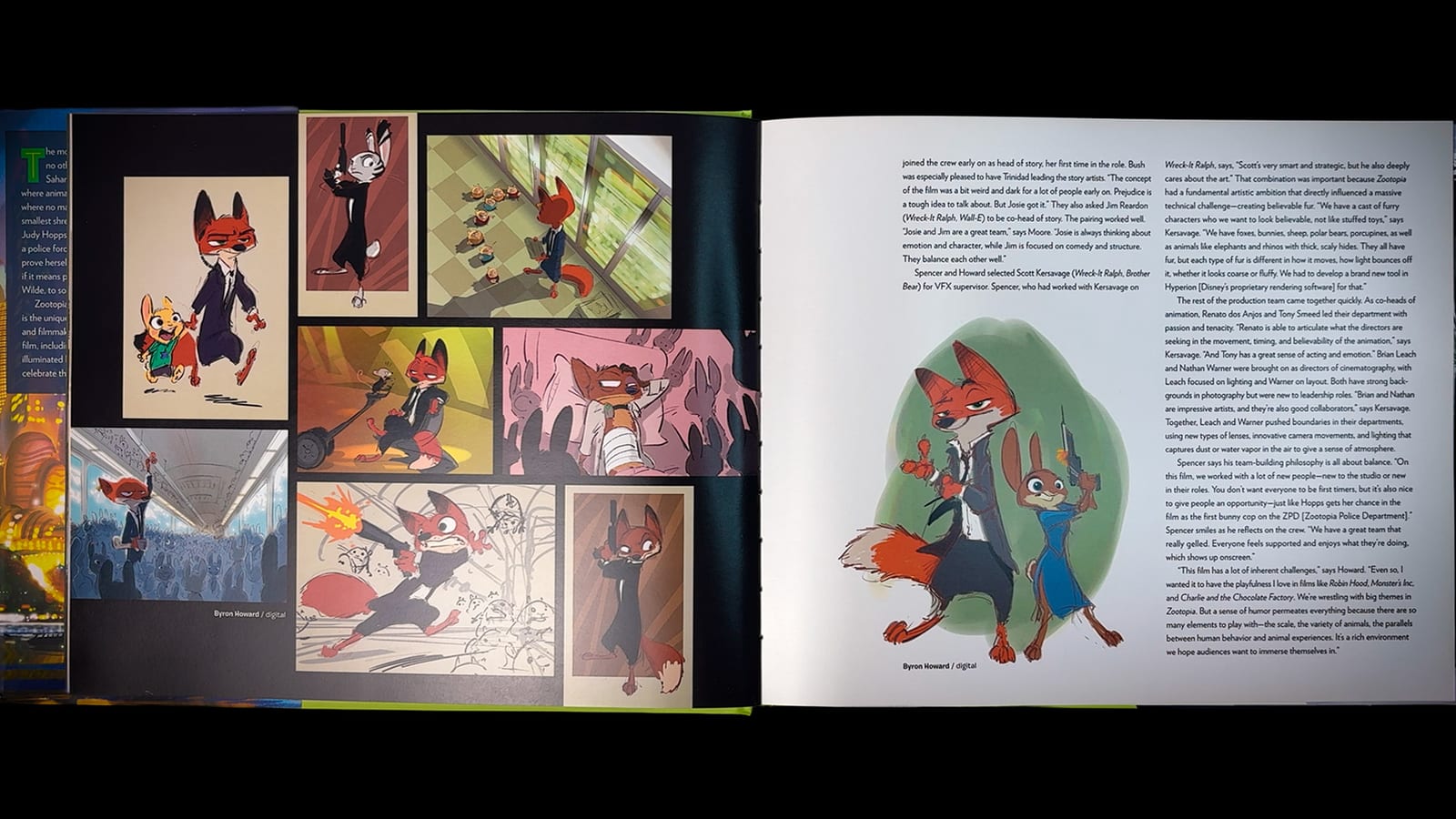
The character section is where the book earns its keep. Judy Hopps goes through dozens of proportion studies before landing on the compact, big-eyed design that made it to screen, and Nick Wilde’s turnarounds show a fox who was, for a long stretch of development, meaner and more cynical than the wisecracking version audiences got. The book doesn’t shy away from the film’s famous mid-production overhaul either — early notes and character sheets make clear that Nick was originally going to carry the story alone, with Judy in a much smaller role, before the whole plot got rebuilt around their partnership. Chief Bogo, Mayor Lionheart, Bellwether and the rest of the supporting cast get their own pages too, several with rejected designs that are stranger and funnier than what shipped.
The journey through the story
Once the leads are established, the book shifts into production order: story sketches, animator notes scrawled in the margins, and beat-by-beat breakdowns of how a scene moved from thumbnail to final shot. It’s a good reminder that a film this polished came out of a lot of trial and error — entire sequences and jokes show up here that never made the final cut.
The worlds
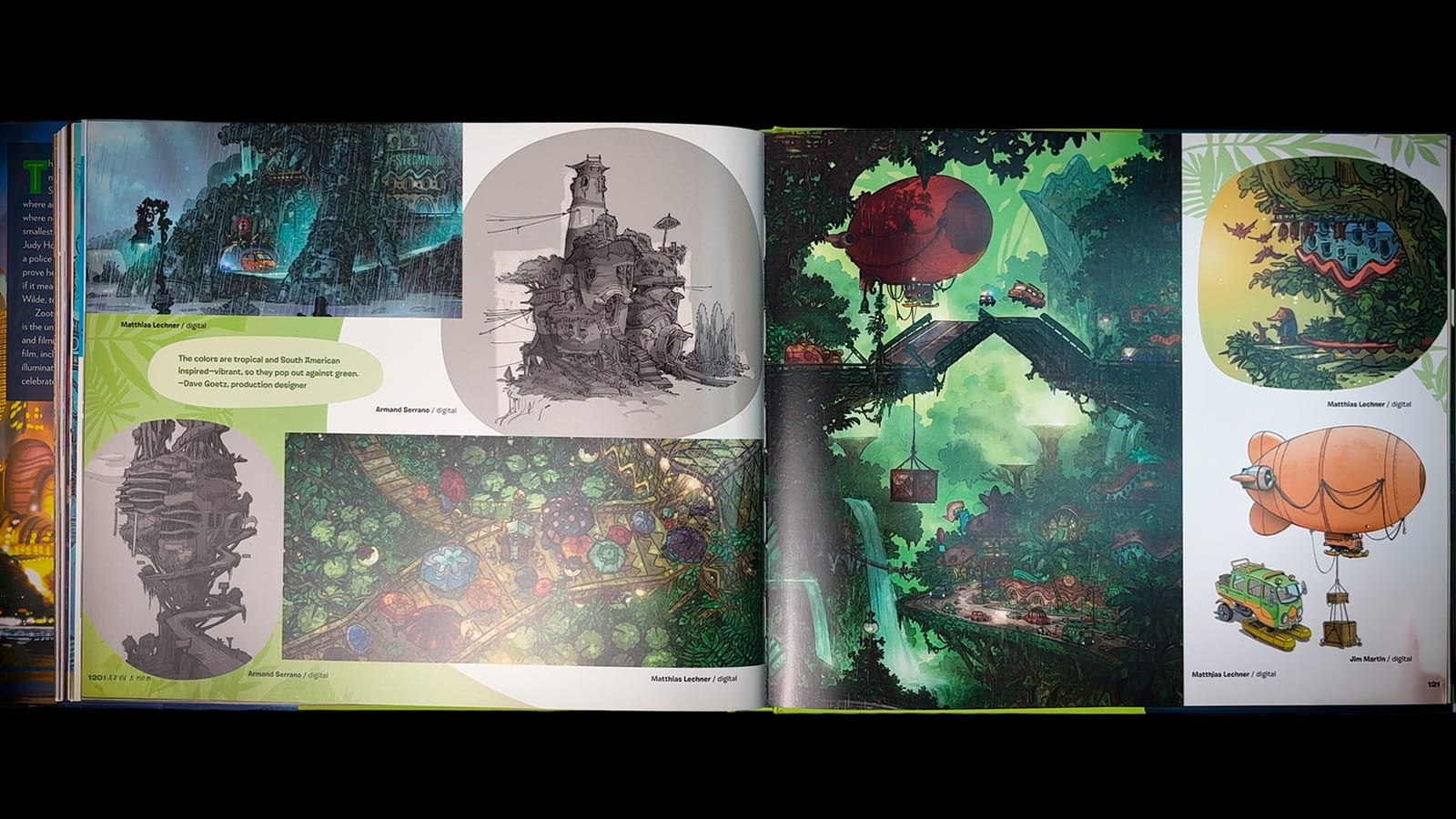
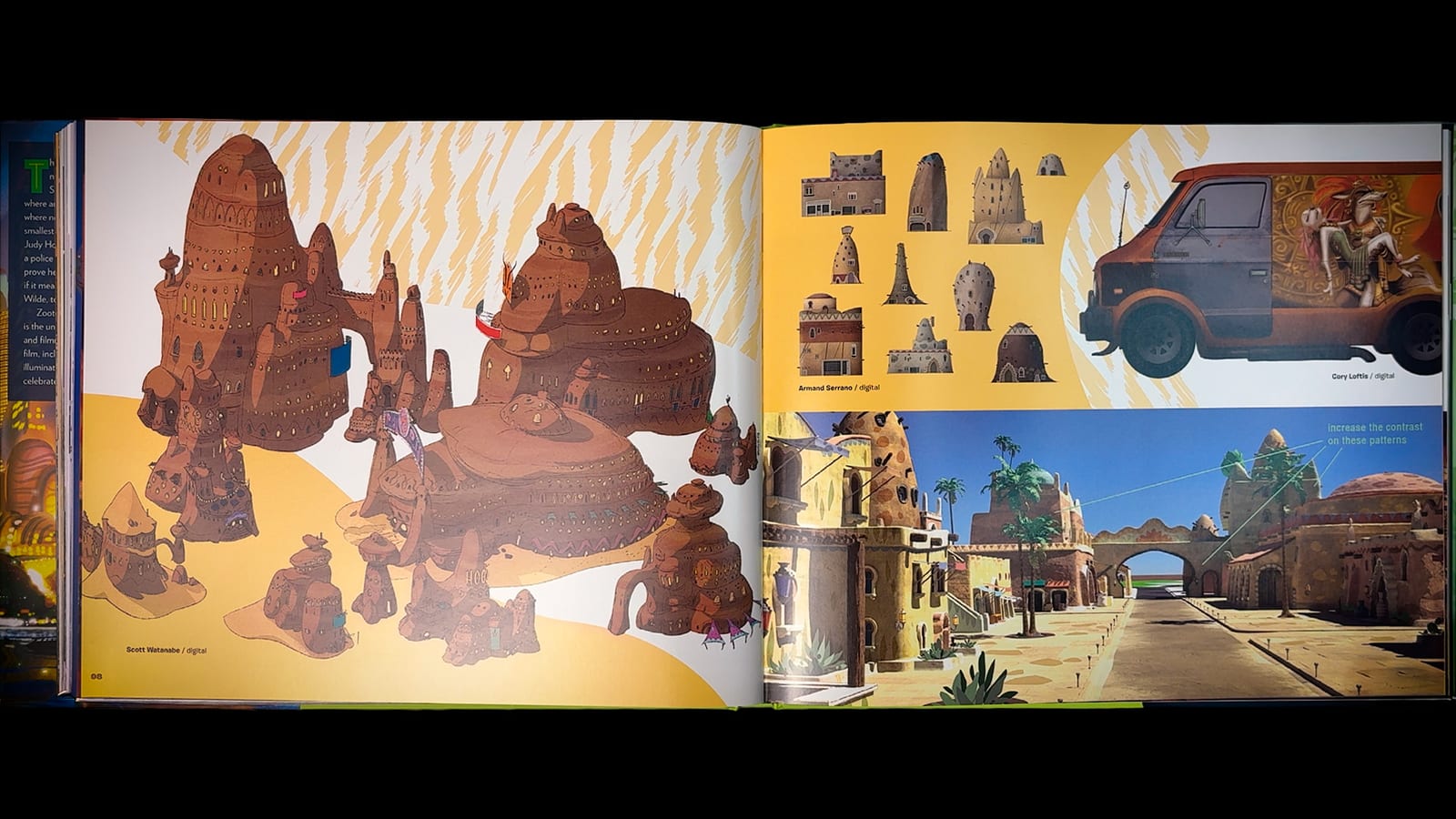
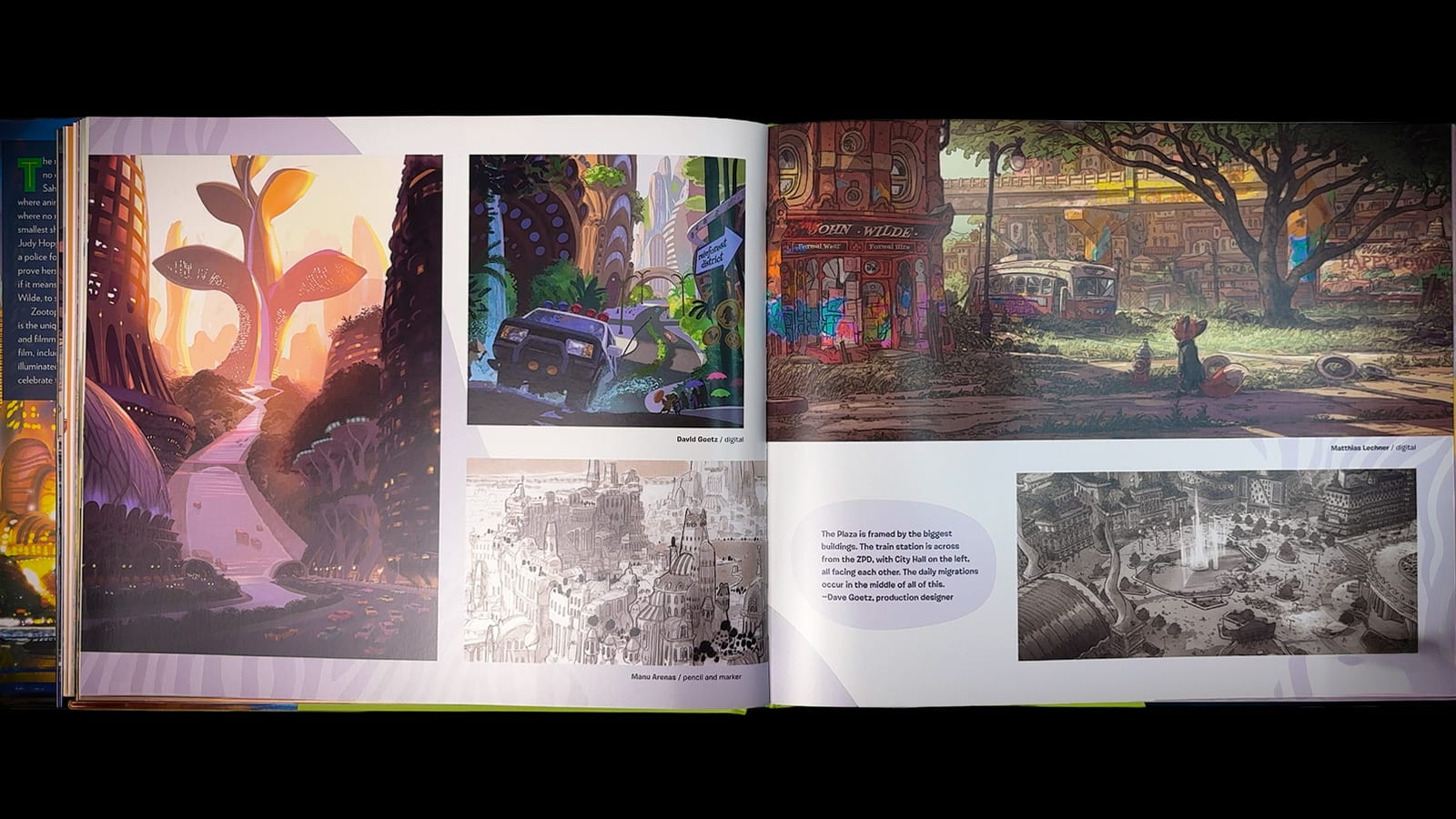
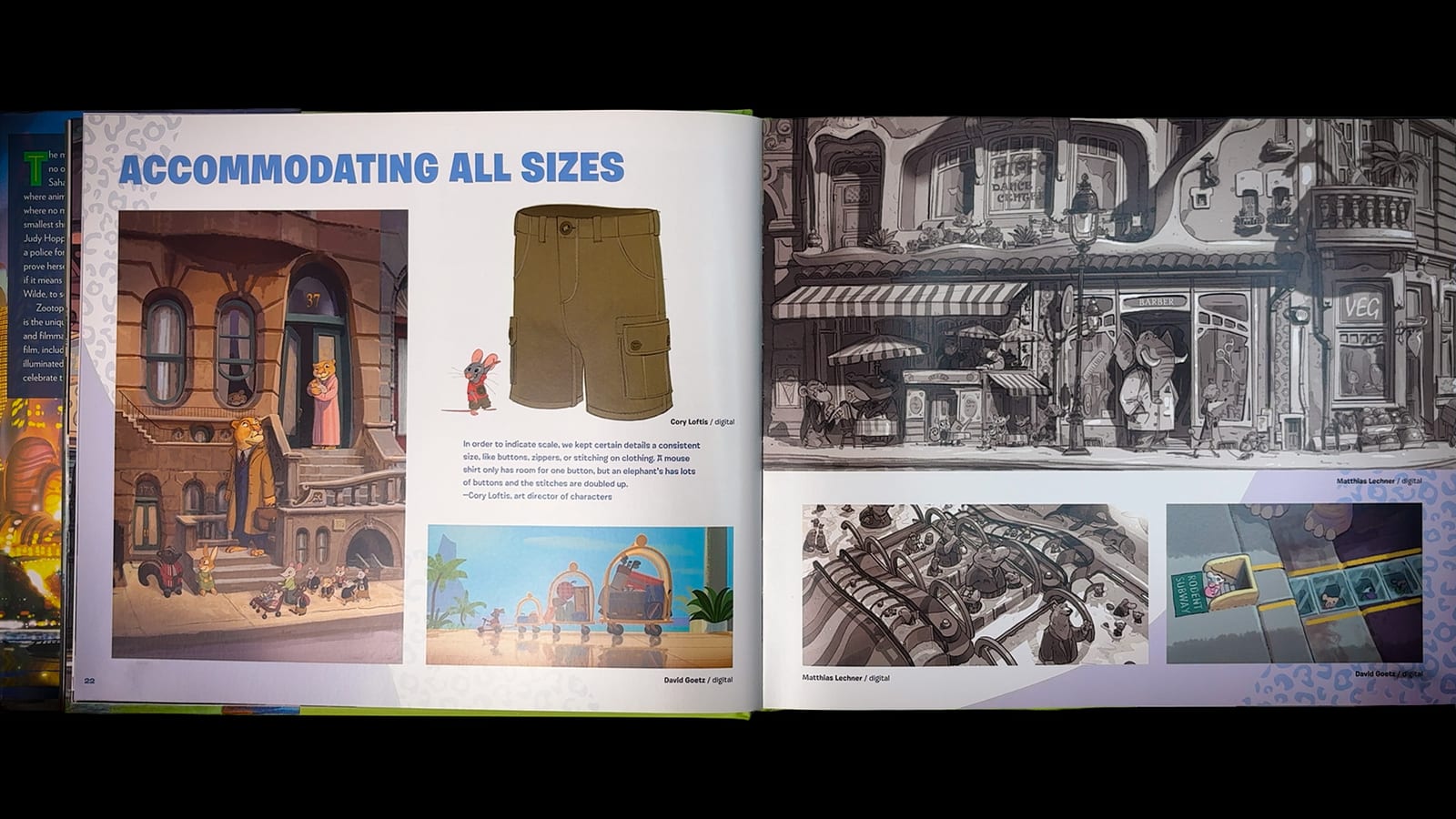
This is the section that makes the book worth owning. Zootopia’s twelve districts get real architectural reasoning, not just pretty backgrounds: Bunnyburrow is built low and burrow-friendly for rabbits, the Rainforest District scales its houses and walkways to trees the size of skyscrapers, and Tundratown and Sahara Square each solve their own climate and size problems in completely different ways. The book explains how the team designed one train car, one doorway, one sidewalk that had to work for a mouse and an elephant simultaneously — and shows the sketches where that math visibly breaks down before it gets solved. The endpapers, printed with fake Zootopia billboards, product logos and news clippings, are a small detail that a lot of readers miss on the first pass.
What’s inside
The book is organized as a guided tour through the production:
- Character design — proportion studies, expression sheets and the personality shifts that came with the story overhaul.
- Districts of Zootopia — twelve neighborhoods, each with its own scale logic and color language.
- Background art — matte paintings and environment keys that never made it past the art department.
- Behind the scenes — director and artist notes explaining why certain ideas were cut.
The district-by-district breakdown alone justifies the price — it’s closer to an urban planning document than a typical concept art gallery.
The artwork
The reproduction here is genuinely clean; the vibrant color work that defines the film comes through without the muddiness or pixelation that shows up in some Disney art books from this era. What stands out most is how much unresolved work gets shown — half-finished environment paintings, character designs with handwritten notes about scale problems, layouts that were later scrapped. It’s less a highlight reel and more a working file, and that’s exactly what makes it interesting.
Video Preview
New artbook videos every week
Subscribe for more animation and concept art content.
▶ Subscribe on YouTubeIs it worth it?
For anyone who loved the film’s world-building — or just wants to see how a story this ambitious got rebuilt mid-production — this is close to essential. The pacing occasionally favors breadth over depth, moving through some districts faster than you’d like, but there’s rarely a spread that feels like filler.
Verdict: a sharp, well-produced look at one of the more thoughtfully designed animated cities of the last decade, with just enough of the messy process on display to make it more than a gallery book.
Value
At $40 / CA$40 / £30 / €46, this one didn’t make me flinch the way some animation artbooks do. 160 pages of the kind of material that usually gets cut — rejected designs, margin notes, the messy middle of production — for a price that’s actually reasonable felt like good value to me, not just something I’m telling myself to justify the purchase.
If you decide to pick it up, the links below are affiliate links. It doesn’t cost you anything extra, and it’s honestly one of the easiest ways to support what I do here.
📚 Want this book? Grab your copy:
As an affiliate, we may earn a small commission from qualifying purchases — at no extra cost to you.
Watch the film on Disney+


